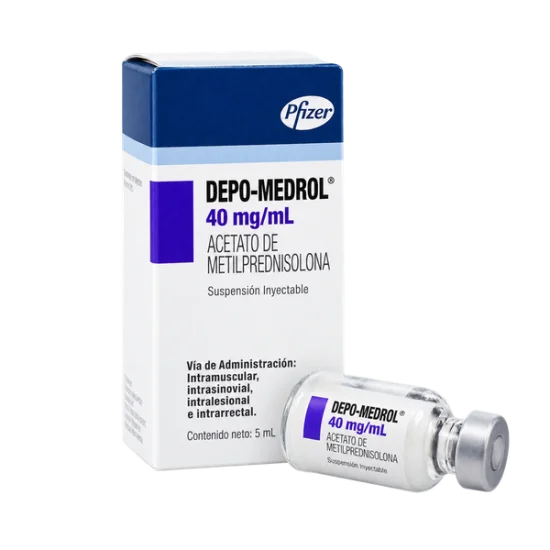
Depo-Medrol
Active ingredient: Methylprednisolone acetate
Delivery: from 4 days
- Worldwide Delivery4-7 business days
- Quality GuaranteedOnly original products
- Bonus pillsSave up to 80%
- 24/7 SupportOur team of pharmacists is available 24/7 to help you
Depo-Medrol contains methylprednisolone acetate, a glucocorticoid that reduces inflammatory signalling and immune-cell activity. It is supplied as an injectable suspension for selected inflammatory and immune-mediated conditions, and the regimen for the chosen strength is confirmed with a healthcare professional before starting.
Product information
Adults with inflammatory, rheumatic, allergic, joint, or immune-mediated conditions may receive Depo-Medrol when a clinician considers a depot corticosteroid appropriate.
Methylprednisolone belongs to the corticosteroid class. Corticosteroids imitate hormones produced by the adrenal cortex and influence genes involved in inflammation, immune responses, blood-vessel permeability, and metabolism.
How it affects the body
Methylprednisolone acetate enters cells and binds to glucocorticoid receptors. This receptor complex changes the activity of inflammatory genes, reducing the production of mediators that promote swelling, pain, redness, and immune-cell recruitment [1].
The anti-inflammatory effect can reduce fluid leakage from small blood vessels and limit the activity of inflammatory cells. The immunosuppressive effect is clinically useful in some immune-mediated disorders, yet it also reduces part of the body’s normal defence against infection.
Glucocorticoid activity drives the main anti-inflammatory action. Mineralocorticoid activity is weaker but can still contribute to fluid retention, blood-pressure changes, or potassium disturbances in susceptible patients.
Ingredients
Active ingredient and dosage form
The active ingredient is methylprednisolone acetate. The acetate form creates a depot suspension, meaning the corticosteroid remains at the injection site and releases gradually rather than entering the bloodstream as one immediate oral dose.
Depo-Medrol is an injectable suspension, not an oral steroid tablet. The regimen for the chosen strength must be confirmed with a healthcare professional before starting.
The injection must be mixed and handled according to the official product information before administration. A cloudy suspension can be normal for this dosage form, while unsuitable handling, contamination, or incorrect anatomical placement can cause harm.
Dosage and administration
Administration routes and injection technique
Depo-Medrol is administered by a qualified clinician through a prescribed route. Possible routes include intra-articular injection and intramuscular injection, depending on the product information and the condition being treated.
The product must not be self-injected. Route selection affects how quickly the medicine acts, where the highest concentration occurs, and which complications are possible.
Intra-articular administration
An intra-articular injection places the suspension into a joint space. The clinician assesses the joint, reviews the diagnosis, and considers infection before proceeding. A painful, hot, swollen joint with fever is not a situation for routine steroid injection until infection has been evaluated.
Intramuscular administration
An intramuscular injection places the suspension into selected muscle tissue. The prescriber determines the site, amount, interval, and need for observation based on the diagnosis and patient factors.
A depot injection cannot be removed easily after administration. This is one reason clinicians review diabetes, blood pressure, infection history, previous steroid reactions, and current medicines before treatment.
Depo-Medrol dosage and dose adjustments
The regimen for the chosen strength is confirmed with a healthcare professional before starting. A Depo-Medrol 40 mg/mL vial is a product strength, not a universal personal dose.
Factors determining the prescribed dose
The prescribed amount and interval may depend on:
- The diagnosis and severity of inflammation.
- The joint, soft tissue, or muscle selected for administration.
- Whether treatment is local or systemic.
- Age, body size, diabetes, hypertension, osteoporosis, glaucoma, and infection risk.
- Previous corticosteroid exposure and response.
- The need to limit repeated injections.
- Other medicines that change infection, glucose, blood-pressure, or bleeding risk.
An intra-articular dose is not interchangeable with an intramuscular dose. The volume in the vial is not a direction to use the entire vial. The same concentration may be used in different clinical situations with different prescribed amounts.
Dose review and repeat injections
Repeat injections should have a clinical reason. Requesting an early injection because pain returned can delay diagnosis of infection, tendon injury, uncontrolled arthritis, or another cause of symptoms.
The treating clinician may decide that a different route, physical rehabilitation, disease-specific therapy, or further investigation is more appropriate. Increasing frequency can raise the risk of cartilage injury, bone effects, glucose elevation, skin changes, infection, and systemic corticosteroid exposure.

When not to use it
Depo-Medrol is not suitable for a person with a known serious hypersensitivity to methylprednisolone or an excipient. Intrathecal administration is not an appropriate route for this product.
An injection should be postponed or avoided when there is suspected infection in the target joint or injection area. Systemic corticosteroid treatment also requires careful assessment during untreated systemic infection.
- A previous severe reaction to corticosteroids.
- A suspected infected joint or untreated serious infection.
- Poorly controlled diabetes.
- Severe hypertension or significant fluid-retention problems.
- Glaucoma or serious eye disease.
- Osteoporosis or a history of steroid-related bone complications.
- A recent or planned live vaccine.
- A bleeding disorder or treatment with anticoagulants.
- A previous severe mood, psychiatric, or adrenal reaction to steroids.
When this is not for you
This medication is not for you without specialist assessment if you have a suspected infected joint or untreated serious infection, poorly controlled diabetes, severe hypertension, glaucoma, osteoporosis, a recent or planned live vaccine, a bleeding disorder, or a previous severe reaction to steroids.
Tell the clinician about fever, active infection, recent vaccination, diabetes, anticoagulants, eye disease, pregnancy, breastfeeding, osteoporosis, and previous steroid reactions before administration.
Possible side effects
Side effects depend on dose, route, injection frequency, treatment duration, and individual susceptibility. Local effects and systemic effects can occur together.
Local injection effects
Short-term soreness or a temporary flare of pain can occur after an intra-articular injection. Skin thinning, lighter skin pigmentation, subcutaneous fat loss, tendon injury, bleeding, or infection at the injection site are possible complications.
Prompt medical assessment is needed for:
- Increasing joint pain, warmth, redness, or swelling.
- Fever or chills after an injection.
- Drainage from the injection site.
- Inability to move the treated joint.
- Facial swelling, wheezing, or widespread hives.
- New visual disturbance.
A joint that becomes more painful and hot several days after injection needs assessment, even if the injection initially reduced symptoms.
Systemic corticosteroid effects
Methylprednisolone acetate can produce systemic effects because some of the medicine enters the circulation. Possible effects include elevated blood glucose, increased appetite, insomnia, mood changes, headache, fluid retention, raised blood pressure, indigestion, menstrual changes, and temporary changes in immune response.
Repeated or substantial exposure can contribute to osteoporosis, muscle weakness, cataracts, glaucoma, adrenal suppression, skin fragility, and slower wound healing. Serious allergic reactions and severe psychiatric reactions are uncommon but require urgent care.
Therapeutic indications
Depo-Medrol may be prescribed for selected inflammatory, rheumatic, allergic, dermatologic, respiratory, soft-tissue, and joint-related conditions. The choice depends on the diagnosis, severity, anatomy involved, previous response, and route of administration.
| Clinical area | Possible treatment rationale | Route consideration |
|---|---|---|
| Joint and soft-tissue inflammation | Reduce local inflammatory swelling, pain, and restricted movement | Intra-articular or soft-tissue administration requires accurate placement |
| Rheumatic or immune-mediated disease | Suppress excessive immune activity during selected flares | Route and repeat treatment require specialist assessment |
| Severe allergic or inflammatory illness | Reduce systemic inflammatory activity when clinically justified | Intramuscular use is determined by the prescriber |
A local injection may help symptoms from bursitis, synovitis, selected arthritis flares, or tendon-sheath inflammation. It does not prove that the joint or tendon has healed. Persistent or recurring symptoms require reassessment of the underlying condition.
Depo-Medrol is not a routine treatment for minor allergy symptoms, uncomplicated viral illness, or an untreated infection. Corticosteroid treatment can mask symptoms while the disease continues.
Comparison
Depo-Medrol, oral steroids, and shorter-acting injectable corticosteroids all reduce inflammation through glucocorticoid activity, yet their practical profiles differ.
| Treatment approach | Main advantage | Main limitation |
|---|---|---|
| Depo-Medrol depot injection | Less frequent dosing and possible local targeting | The dose cannot be rapidly withdrawn after injection |
| Oral corticosteroid | Dose can usually be adjusted or stopped more readily | Daily administration and broader systemic exposure |
| Shorter-acting injection | More flexible duration in selected situations | May require repeat administration or a different clinical setting |
An oral steroid may be preferred when rapid dose adjustment is needed, when treatment duration must be changed frequently, or when systemic therapy is required with close control. A depot injection may be considered when local treatment is appropriate or adherence to repeated oral doses is difficult.
An injection is not automatically stronger or better. The diagnosis, urgency, anatomy, comorbidities, expected duration, and need for reversibility guide the choice.
Common mistakes
- Treating the full 40 mg/mL vial as an automatic dose.
- Asking for another injection as soon as pain returns.
- Failing to mention fever, antibiotics, or an infected wound.
- Assuming an injection into a joint has no effect on blood glucose or blood pressure.
- Resuming strenuous activity because pain improved before tissue healing occurred.
- Omitting supplements, anticoagulants, vaccines, or non-prescription medicines from the medication history.
- Ignoring a hot, swollen joint after the initial pain has improved.
- Expecting a corticosteroid injection to cure a mechanical joint problem, untreated infection, or progressive autoimmune disease.
What doctors say
Clinicians generally assess the cause of inflammation before using a depot corticosteroid. The practical question is not only whether symptoms may improve, but whether the route and duration fit the diagnosis.
Before the appointment, prepare the following information:
- Current medicines, including anticoagulants and diabetes treatment.
- Recent infections, antibiotics, vaccines, or surgery.
- Previous corticosteroid injections and any reactions.
- Diabetes, glaucoma, osteoporosis, hypertension, or heart disease.
- Pregnancy or breastfeeding status.
- The exact joint or area affected and how symptoms have changed.
After administration, monitor the treated area and general health. Worsening pain with fever, severe allergy symptoms, major glucose changes, marked weakness, or visual symptoms should prompt urgent medical attention.
Common questions
Is Depo-Medrol suitable for older adults?
Older adults can receive Depo-Medrol when the expected benefit outweighs the risks. Assessment should include bone health, diabetes, blood pressure, glaucoma, infection risk, kidney function, and other medicines. The FDA prescribing information reviewed in 2025 highlights corticosteroid-related metabolic, immune, and musculoskeletal effects that can matter more when several chronic conditions are present. Age alone does not determine eligibility. Clinical assessment can also use National Institute for Health and Care Excellence (NICE) guidance on monitoring corticosteroid-related risks.
Can alcohol be used while receiving Depo-Medrol?
Alcohol is not a direct antidote to methylprednisolone acetate, but heavy alcohol use can worsen stomach irritation, sleep disturbance, blood-glucose control, blood pressure, and bone health. The FDA product information available in 2025 supports reviewing gastrointestinal and metabolic risks when corticosteroids are used. Avoiding heavy drinking around treatment is sensible, especially when other medicines or a history of ulcers, diabetes, or liver disease is present.
Can Depo-Medrol cause insomnia?
Yes. Corticosteroid exposure can cause insomnia, restlessness, mood changes, or unusual mental energy in some people. FDA safety information current in 2025 recognises sleep and psychiatric effects as possible corticosteroid reactions. Severe agitation, confusion, hallucinations, or thoughts of self-harm require urgent medical attention rather than another dose or sedative taken independently.
What should happen after a missed injection or delayed application?
Do not arrange a replacement dose or double the next treatment without the prescribing clinician’s instructions. Contact the treating service and provide the intended date, indication, and any change in symptoms. MOHAP guidance for safe medicine use in the UAE, published in 2025, supports resolving missed treatment through the responsible prescriber, because the correct plan depends on whether the injection was for a joint, soft tissue, or systemic condition.
Which condition can rule out a Depo-Medrol injection?
A suspected untreated infection in the target joint or injection area can rule out or postpone an intra-articular injection until assessment is complete. The EMA product information framework for corticosteroids in 2024 emphasises infection-related precautions and route-specific safety considerations. A previous serious hypersensitivity reaction, uncontrolled medical illness, or a planned live vaccine may also require a different treatment plan.
Can Depo-Medrol affect driving, concentration, or machinery work?
Some people experience dizziness, insomnia, blurred vision, mood changes, or weakness after corticosteroid treatment, while others notice no impairment. WHO medicine-safety principles published in 2024 support avoiding safety-sensitive tasks when a medicine causes symptoms that affect alertness or vision. Do not drive or operate machinery until you know how the injection affects you, and obtain urgent assessment for new visual disturbance or severe weakness.
Do you offer anonymous delivery?
Your order will be securely packed and shipped within 24 hours. This is exactly what your package will look like (images of an actual item sent). It has the size and look of a regular private letter (24x11x0.7 cm) and its contents cannot be seen.
Comparison
Sources
- U.S. Food and Drug Administration (2024). Depo-Medrol (methylprednisolone acetate injectable suspension) Prescribing Information.