24/7 SupportOur team of pharmacists is available 24/7 to help you
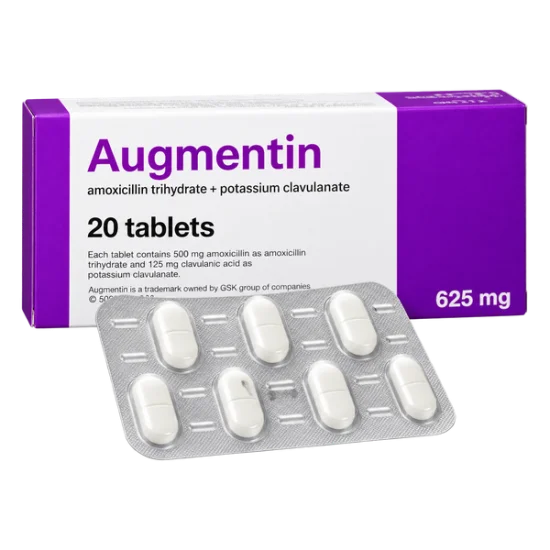
Augmentin is co-amoxiclav, a penicillin antibiotic combining amoxicillin with clavulanic acid. It is prescribed for selected susceptible bacterial infections, and the regimen for the chosen strength should be confirmed with a healthcare professional before starting.
Product information
Augmentin is the brand name for co-amoxiclav, a penicillin antibiotic combining amoxicillin with clavulanic acid. The product belongs to the beta-lactam antibiotic group and the penicillins class.
How it affects the body
Amoxicillin damages the bacterial cell-wall construction process. Clavulanic acid blocks certain beta-lactamase enzymes, which some bacteria produce to break down penicillin antibiotics. It protects amoxicillin from those enzymes, allowing the antibacterial component to act against susceptible organisms. Clavulanic acid does not independently treat an infection. Its activity depends on the antibacterial action of amoxicillin.
Ingredients
The tablet contains amoxicillin, supplied as amoxicillin trihydrate, and clavulanic acid, supplied as potassium clavulanate. This combination is also described as amoxicillin plus clavulanic acid.
Active Ingredients and Pharmaceutical Class
The active ingredients are:
Amoxicillin, a penicillin antibacterial.
Clavulanic acid, a beta-lactamase inhibitor.
Amoxicillin trihydrate and potassium clavulanate, the salt forms used in the tablet.
The stated tablet strength refers to the combined amount of these two active components, not to amoxicillin alone.
Beta-Lactamase Protection
Beta-lactamases can open the beta-lactam ring found in penicillin antibiotics. Clavulanic acid resembles the bacterial target of these enzymes and helps protect amoxicillin from certain beta-lactamases. The protection has limits, so Augmentin does not overcome resistance in every bacterium. Culture testing may guide antibiotic selection in recurrent, severe, or complicated infections.
Taking Augmentin at the start of a meal can reduce stomach upset and helps ensure that clavulanic acid is absorbed with food.
The US Food and Drug Administration describes Augmentin as an oral combination of amoxicillin and clavulanate potassium for susceptible bacterial infections [1].
Dosage and administration
The regimen for the chosen Augmentin strength must be confirmed with a healthcare professional before starting. The number of daily doses and treatment duration depend on the infection, age, kidney function, severity, and local clinical guidance.
Take the tablet by mouth with a meal.
Swallow it with water.
Space doses as evenly as the prescribed schedule permits.
Take the full prescribed course.
Do not take more than the recommended dose.
If a dose is missed, take it when remembered unless the next dose is close; do not double the next dose.
A consistent breakfast-and-evening routine can help people remember a twice-daily regimen when that schedule has been prescribed. Feeling better does not prove that the infection has cleared. Stopping early can leave bacteria behind and may contribute to treatment failure.
If vomiting occurs soon after a dose, the correct action depends on the timing and whether the tablet was retained. Repeating doses without specific advice can cause an accidental excess.
Food Timing and Dose Spacing
Food is preferred because clavulanic acid can cause gastrointestinal discomfort. A meal does not make Augmentin treat viral symptoms, and taking it with food does not replace accurate dose spacing.
Missed Doses and Course Completion
Do not save unused tablets for a future cough, sore throat, or urinary symptom. A later illness may have a different cause or require a different antibiotic. Unused antibiotics should not be shared with another person.
Common Administration Mistakes
Common problems include taking the tablet on an empty stomach, taking two tablets after a missed dose, stopping when fever falls, and using leftover tablets for a new illness. Another mistake is assuming that a larger-looking tablet is automatically more suitable. Strength selection depends on the diagnosis and patient factors.
If swallowing is difficult, do not crush or chew the tablet without confirming that the specific formulation can be altered. A suitable liquid formulation may be prescribed when needed.
When not to use it
Important precautions include:
Previous jaundice or liver injury linked to Augmentin or another penicillin antibiotic.
Severe allergy to penicillins or certain cephalosporins.
Kidney disease or reduced kidney function.
Glandular fever or suspected infectious mononucleosis.
A history of severe antibiotic-associated diarrhoea.
Pregnancy or breastfeeding, where the prescriber should assess the infection and treatment choice.
Multiple medicines that may interact with amoxicillin or clavulanic acid.
When this is not for you
This medication is not for you if you have had a severe immediate reaction to penicillins, amoxicillin, clavulanate, or a related beta-lactam antibiotic, unless a specialist has assessed the allergy and provided a clear plan.
Do not test Augmentin at home if a previous antibiotic caused breathing difficulty, facial swelling, collapse, widespread hives, or a severe blistering rash. A vague history of nausea is different from an allergic reaction, but it should still be described accurately before treatment.
Possible side effects
The common adverse effects of Augmentin involve the digestive system. Nausea, loose stools, diarrhoea, abdominal discomfort, and vomiting may occur. Oral thrush or vaginal thrush can also develop after antibiotic treatment because normal microbial balance may change.
Taking the tablet with food may reduce nausea. Persistent, severe, watery, or bloody diarrhoea needs medical assessment during treatment or after the final dose. Do not self-treat severe antibiotic-associated diarrhoea with an anti-diarrhoeal product before receiving specific advice.
Common effects that may be monitored include:
Mild nausea or stomach discomfort.
Loose stools.
Mild vomiting.
Oral or vaginal thrush.
Mild skin rash, which still needs attention if it spreads or progresses.
Seek urgent medical help for facial or throat swelling, breathing difficulty, collapse, rapidly spreading hives, blistering skin, skin peeling, severe weakness, or a widespread rash with fever. Yellowing of the eyes, dark urine, pale stools, or severe itching may signal liver injury and requires prompt assessment.
Serious diarrhoea can occur during or after antibiotic exposure. The FDA prescribing information identifies gastrointestinal effects, allergic reactions, liver-related reactions, and antibiotic-associated colitis among clinically relevant safety concerns [3].
Diarrhoea that is bloody, severe, or accompanied by dehydration is not an ordinary minor side effect. Avoid taking an anti-diarrhoeal medicine until a clinician has assessed the symptoms.
Therapeutic indications
Augmentin may be prescribed when a clinician considers a susceptible bacterial infection likely or when testing identifies bacteria responsive to co-amoxiclav. Common clinical uses include selected sinus, throat, chest, skin, dental, and urinary tract infections.
Skin and soft-tissue infection, dental infection, or urinary infection when the organism and patient factors support treatment
A sore throat, coloured mucus, fever, or cough does not prove that bacteria are responsible. Viral infections can produce the same symptoms. The choice of antibiotic depends on the suspected organism, local resistance patterns, infection severity, allergy history, kidney function, liver history, and any culture result.
Respiratory symptoms need prompt assessment when breathing becomes difficult, chest pain develops, confusion appears, or fever persists or worsens. Urinary infections may require urine culture, especially when symptoms recur, pregnancy is present, kidney disease exists, or there is flank pain. A wound infection may need physical assessment and drainage as well as an antibiotic.
The World Health Organization emphasises antimicrobial stewardship: antibiotics should be selected for a likely or confirmed bacterial infection and used for the prescribed duration [2].
Respiratory and Ear-Nose-Throat Infections
Augmentin may be considered for selected bacterial sinus, throat, ear, or chest infections. It is not a treatment for influenza or an ordinary cold. Sinus pressure alone does not establish bacterial sinusitis, and mucus colour alone cannot identify the cause.
Skin and Urinary Tract Infections
Skin redness spreading quickly, severe tenderness, tissue swelling, or fever requires timely medical review. Urinary symptoms with fever, vomiting, back pain, or reduced urine output may indicate a more serious infection requiring assessment rather than self-treatment.
Comparison
Co-amoxiclav is the generic name for the combination of amoxicillin and clavulanic acid. Augmentin and another co-amoxiclav product may contain the same active substances, yet products are interchangeable only when the strength, ratio, dosage form, and prescribed instructions match.
Treatment category
Active combination
Selection point
Augmentin 625 mg tablet
Amoxicillin 500 mg plus clavulanic acid 125 mg
Use the prescribed regimen for the diagnosed infection
Equivalent co-amoxiclav therapy
Amoxicillin plus clavulanic acid
Match both active amounts, not merely the tablet count
Alternative antibiotic class
A different antibacterial substance
Chosen when allergy, resistance, infection site, or organ function requires it
Common mistakes
Common Patient Mistakes
Taking the tablet without food when it causes repeated nausea.
Doubling the next dose after forgetting one.
Stopping as soon as pain or fever improves.
Using Augmentin for a cold or influenza.
Sharing tablets with a child, partner, or family member.
Taking an anti-diarrhoeal product despite severe watery or bloody stools.
Failing to mention warfarin, methotrexate, kidney disease, or a previous penicillin reaction.
Keep a simple morning-and-evening reminder when that schedule has been prescribed, but never change the number of daily doses without the prescriber’s direction.
What doctors say
In clinical practice, prescribers commonly check the allergy history, infection site, recent antibiotic exposure, kidney function, liver history, and current medicines before selecting Augmentin. Pharmacists commonly check meal timing, dose spacing, the prescribed duration, and the ability to swallow the tablet.
Augmentin works by stopping bacterial growth in susceptible organisms. Pain and fever may improve as the infection responds, but symptom relief does not prove that every bacterium has been eliminated. A fixed recovery time cannot be promised because the infection site and underlying health strongly influence response.
Clinical Monitoring Points
Contact the treating service promptly if symptoms worsen, fever persists, breathing becomes difficult, confusion develops, hydration becomes difficult, or redness spreads rapidly. Delayed diarrhoea can occur after the last tablet, so new gastrointestinal symptoms should not automatically be dismissed as unrelated.
Common questions
Can older adults take Augmentin?
Older adults can use Augmentin when a clinician considers it suitable, with attention to kidney function, liver history, allergies, and interacting medicines. The EMA product information (2018) and MOHAP guidance support individual dose assessment when renal function is reduced. A medication review is helpful when several treatments are taken together. Seek prompt care for confusion, dehydration, jaundice, or severe diarrhoea.
How does Augmentin differ from an antibiotic containing amoxicillin alone?
Augmentin combines amoxicillin with clavulanic acid, while amoxicillin alone contains only the penicillin antibacterial component. Clavulanic acid blocks certain beta-lactamases, so the combination can cover bacteria that may resist amoxicillin alone. The WHO antibiotic guidance published in 2022 stresses that broader coverage does not make co-amoxiclav suitable for every infection. Selection depends on the organism, infection site, allergy history, and local resistance.
How long does one Augmentin dose keep working?
A dose works within the body for the interval set by the prescribed schedule, rather than providing protection for an entire day regardless of timing. The FDA Augmentin label (2021) explains that dosing depends on the formulation, infection, age, and kidney function. Keep doses evenly spaced as directed, and do not take an extra tablet because symptoms return before the next scheduled dose. Worsening symptoms need clinical review.
Can an Augmentin tablet be split, crushed, or chewed?
Do not crush or chew Augmentin tablets unless a pharmacist or prescriber confirms that the specific tablet can be altered. The NHS medicine guidance available in 2025 advises swallowing tablets according to the product instructions and using a suitable liquid formulation when swallowing is difficult. Splitting can also make it harder to receive the intended amoxicillin-to-clavulanate ratio. A child should not receive a portion of an adult tablet as an estimated dose.
Can Augmentin be combined with warfarin?
Augmentin can be prescribed with warfarin in some situations, but the combination requires the prescriber to consider INR monitoring. The EMA product information (2018) identifies antibiotic treatment, infection, and changes in gut vitamin K production as factors that may affect anticoagulation. Do not change warfarin or skip INR testing independently. Report unusual bruising, nosebleeds, blood in urine, or black stools promptly.
Can people under 18 use Augmentin?
Children and adolescents can receive Augmentin when a qualified prescriber selects the correct formulation and weight-based regimen. The FDA (2021) and WHO (2022) stress that paediatric dosing depends on body weight, infection, kidney function, and the amoxicillin-to-clavulanate ratio. Do not calculate a child’s dose from an adult tablet or use leftover treatment. A liquid formulation may be more appropriate when swallowing tablets is difficult.
Do you offer anonymous delivery?
Your order will be securely packed and shipped within 24 hours. This is exactly what your package will look like (images of an actual item sent). It has the size and look of a regular private letter (24x11x0.7 cm) and its contents cannot be seen.
U.S. Food and Drug Administration (2021). AUGMENTIN (amoxicillin/clavulanate potassium) prescribing information.
World Health Organization (2022). The WHO AWaRe Antibiotic Book: Antibiotic use for common infections in children and adults.
U.S. Food and Drug Administration (2021). AUGMENTIN Medication Guide.
How Buyers Rate Augmentin
3.8Based on 3 reviews
S
Saeed, 59Umm Al Quwain7-day course
11 Nov 2026
Rating: 4.5 out of 5
I used Augmentin for a bacterial chest infection. The fever and chest discomfort eased over the course, and swallowing the tablets with breakfast and dinner was straightforward. I was satisfied with the improvement.
J
John, 26Kalba7-day course
15 Oct 2026
Rating: 4 out of 5
Augmentin helped with a painful dental infection. The swelling reduced and eating became easier after treatment began. Taking each tablet with a proper meal fitted well into my workday.
U
Usman F., 51Al Barsha7-day course
23 Oct 2026
Rating: 3 out of 5
The infection improved, but the progress was slower than I expected and I had loose stools during the course. I finished the prescribed treatment, then spoke with a doctor because the diarrhoea continued for several days.