Ampicillin
Active ingredient: Ampicillin
Delivery: from 4 days
- Worldwide Delivery4-7 business days
- Quality GuaranteedOnly original products
- Bonus pillsSave up to 80%
- 24/7 SupportOur team of pharmacists is available 24/7 to help you
Ampicillin may be prescribed for adults and children when a susceptible bacterial infection is confirmed or strongly suspected. As a penicillin-class beta-lactam antibiotic, it helps treat selected infections by blocking bacterial cell-wall synthesis.
Product information
Adults and children with a confirmed or strongly suspected susceptible bacterial infection may be prescribed Ampicillin, a penicillin-class beta-lactam antibiotic. It blocks bacterial cell-wall synthesis and may treat selected Gram-positive and Gram-negative infections. It does not treat colds or influenza.
How it affects the body
Ampicillin binds to bacterial penicillin-binding proteins. These proteins help link strands of peptidoglycan, the strong mesh that gives a bacterial cell wall its shape. When this process is interrupted, the growing bacterium can lose wall integrity and die.
Cell Wall Synthesis Inhibition
The bacterial cell wall protects the organism from pressure inside the cell. Ampicillin prevents the final cross-linking steps needed to strengthen that wall. Human cells do not have peptidoglycan cell walls, which explains why this target is selective for bacteria.
The effect is strongest against actively multiplying organisms. A person may not feel better immediately because symptom improvement also depends on the infection site, bacterial load, inflammation, and the body’s immune response.
Gram-Positive and Gram-Negative Coverage
Gram-positive bacteria have a relatively exposed, thick peptidoglycan layer. Gram-negative bacteria have a thinner peptidoglycan layer surrounded by an additional outer membrane. Ampicillin can act against selected organisms from both groups when laboratory testing confirms susceptibility.
Resistance patterns vary between bacterial species, strains, hospitals, and communities. A bacterium’s name alone cannot guarantee that Ampicillin will work. The infection site and susceptibility result guide the choice.
WHO antimicrobial guidance supports using the narrowest suitable antibiotic when the causative organism is known, because unnecessary broad exposure increases selection pressure for resistant bacteria [1].
Ingredients
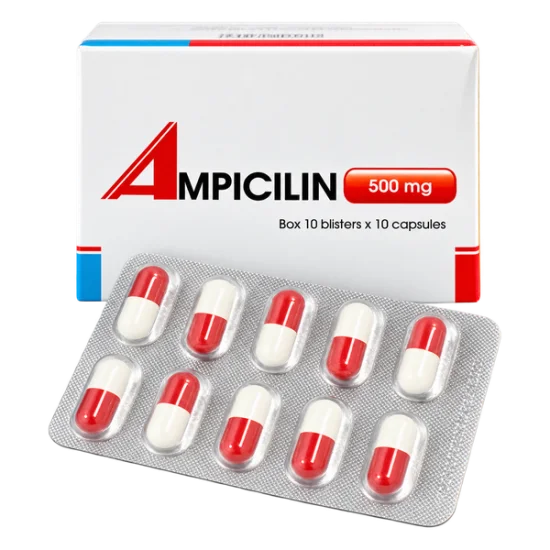
Ampicillin contains ampicillin, an aminopenicillin in the beta-lactam antibiotic group. The capsule form contains ampicillin trihydrate, while injectable preparations use ampicillin sodium. The product sold here is a capsule presentation containing 500 mg of ampicillin per capsule. The formulation affects how the medicine is administered and monitored. It does not determine whether a bacterial isolate is susceptible.
Ampicillin acts against susceptible bacteria by interfering with the structures that maintain their cell walls. Treatment selection depends on the infection site, bacterial susceptibility, kidney function, age, allergy history, and local prescribing guidance. Ampicillin is not suitable for every bacterial infection because resistance can make some organisms insensitive to it.
Pharmacological Class and Active Ingredient
Ampicillin is an aminopenicillin and antibacterial agent. Its active ingredient is ampicillin trihydrate in oral capsules. Like other penicillins, it works during bacterial growth by targeting cell-wall construction rather than human cells.
The term “beta-lactam” describes a chemical structure shared by penicillins and several related antibiotic families. This structure is essential to the antibacterial action of ampicillin, but it can also be broken down by enzymes produced by resistant bacteria.
Dosage and administration
- Dose: Each capsule contains 500 mg of Ampicillin; the prescribed amount in mg differs between users and infection types, so there is no single dose for everyone.
- Frequency: Take the prescribed number of capsules at the prescribed frequency; the available information does not establish a universal number of doses per day.
- Timing: Take each capsule at the prescribed times. No specific before-meal or after-meal schedule is established here.
- Duration: Complete the prescribed treatment duration unless a clinician changes the plan because of an adverse reaction, culture result, or treatment failure.
- Route: Take the capsules by mouth with water and swallow them whole. Do not use them as an injection or by any other route.
When not to use it
Ampicillin is not suitable for everyone. The following situations require avoidance or specific clinical review:
- Previous anaphylaxis or severe immediate allergy to ampicillin, penicillin, or a related beta-lactam
- Previous severe blistering or peeling skin reaction linked to an antibiotic
- Significant kidney impairment requiring dose adjustment
- A history of severe antibiotic-associated colitis
- Suspected infectious mononucleosis with a need to avoid an unnecessary aminopenicillin rash
- Pregnancy or breastfeeding when the infection and antibiotic choice have not been assessed
- Use of medicines that may require additional monitoring during antibiotic treatment
When this is not for you
This medication is not for you if you have had breathing difficulty, facial swelling, circulatory collapse, or a severe skin reaction after a penicillin antibiotic and the reaction has not been medically reviewed.
Possible side effects
Ampicillin can cause gastrointestinal symptoms, skin reactions, and allergic reactions. The intensity and timing matter. Mild nausea is managed differently from facial swelling or a rapidly spreading rash.
Common Digestive and Skin Effects
Possible effects include:
- Nausea or reduced appetite
- Loose stools or diarrhoea
- Abdominal discomfort
- Mild skin rash
- Injection-site pain or redness with injectable treatment
A mild rash can occur during treatment, but a rash that spreads quickly, blisters, peels, involves the mouth or eyes, or appears with swelling requires urgent assessment. Persistent or severe diarrhoea can indicate antibiotic-associated colitis and should not be ignored.
Penicillin Allergy and Severe Reactions
A serious allergic reaction may include wheezing, difficulty breathing, throat tightness, swelling of the lips or tongue, faintness, or widespread hives. Stop taking further capsules and seek emergency help if these symptoms occur.
A documented penicillin allergy should be reviewed before another beta-lactam antibiotic is prescribed. Some people with a prior mild rash may have a different risk profile from someone who experienced anaphylaxis, but the distinction requires clinical assessment.
A rash during ampicillin treatment can also occur in people with infectious mononucleosis. This reaction does not automatically prove a lifelong penicillin allergy, so the event should be recorded accurately and assessed by a clinician.
Interactions and Clinical Precautions
Relevant medicines and conditions should be reviewed before treatment. The prescriber may need to consider anticoagulants, medicines affecting kidney function, other antibiotics, and laboratory monitoring requirements.
Pregnancy and breastfeeding require an individual benefit–risk assessment. Ampicillin has been used in pregnancy when clinically indicated, but the infection and treatment choice still require medical review.

Therapeutic indications
Appropriate Bacterial Infection Use
Clinicians may use Ampicillin for susceptible infections involving the respiratory tract, urinary tract, gastrointestinal tract, skin, soft tissues, or bloodstream, depending on local guidance and microbiology results. The precise indication depends on the organism and the body site involved.
A culture or susceptibility test may be needed when the infection is severe, recurrent, hospital-acquired, or unlikely to respond to standard treatment. Antibiotics do not treat viral infections such as uncomplicated influenza or most common colds.
Comparison
Antibiotic selection depends on diagnosis, susceptibility, infection site, allergy history, organ function, and local resistance patterns. A broader or newer-sounding antibiotic is not automatically the better option.
| Antibiotic | Class and mechanism | Main selection considerations |
|---|---|---|
| Ampicillin | Aminopenicillin; blocks bacterial cell-wall synthesis | Susceptibility, penicillin allergy, renal function, infection site |
| Amoxicillin | Aminopenicillin; blocks bacterial cell-wall synthesis | Related activity, different prescribing patterns and pharmacokinetics |
| Azithromycin | Macrolide; inhibits bacterial protein synthesis | Macrolide susceptibility, cardiac risk factors, infection type |
| Tetracyclines | Tetracycline class; inhibits bacterial protein synthesis | Age, pregnancy, interactions, photosensitivity, organism susceptibility |
Ampicillin and Amoxicillin
Amoxicillin and ampicillin belong to the same broad penicillin family and share a cell-wall mechanism. Their absorption, dosing schedules, approved uses, and local resistance patterns can differ.
Do not substitute amoxicillin for Ampicillin without prescriber approval. The correct choice depends on the infection and the susceptibility profile, not simply on the fact that both are penicillins.
Ampicillin and Azithromycin
Azithromycin is a macrolide antibiotic with a different mechanism. It may be selected when a susceptible organism requires macrolide treatment or when a penicillin cannot be used, though resistance and drug-specific safety factors remain relevant.
A history of penicillin allergy does not automatically make azithromycin the best replacement. The infection site, likely organism, cardiac history, and local guidance still matter.
Ampicillin and Tetracyclines
Tetracyclines inhibit bacterial protein production rather than cell-wall construction. They have their own restrictions and interactions, including considerations related to pregnancy, age, sun exposure, and co-administered medicines.
Antibiotic selection should be diagnosis-led. Taking a different antibiotic because it seems stronger can delay appropriate therapy and increase adverse effects or resistance.
Common mistakes
- Using Ampicillin for a cold or influenza: antibiotics do not kill viruses.
- Sharing capsules: the other person may have a different infection, allergy risk, kidney function, or required dose.
- Stopping as soon as symptoms improve: early stopping can leave viable bacteria and complicate treatment decisions.
- Doubling after a missed dose: this can increase adverse effects without restoring the intended schedule.
- Changing from capsules to injections: the route and formulation are not interchangeable.
- Ignoring diarrhoea after treatment: persistent watery diarrhoea may need assessment for antibiotic-associated colitis.
- Failing to mention a previous penicillin reaction: allergy information can change antibiotic selection.
- Using old leftover capsules: the medicine may be unsuitable for the new illness and the remaining quantity may not complete treatment.
One practical mistake is treating a mild rash and a severe allergic reaction as the same event. Breathing problems, facial swelling, faintness, blistering, or mucosal sores require urgent care rather than observation at home.
What doctors say
In clinical practice, doctors focus first on whether the infection is bacterial and whether the organism is likely to be susceptible. They then consider the site of infection, severity, allergy history, kidney function, age, pregnancy status, and previous antibiotic exposure.
A clinician may request a culture when symptoms are severe, treatment has failed, the infection has returned, or resistance is suspected. Culture results can support a narrower antibiotic or a change in treatment.
The most useful prescribing pattern is targeted treatment at the correct interval for the intended duration. Leftover capsules, shared antibiotics, and self-directed changes make it harder to judge whether the original infection is improving.
Common questions
Is Ampicillin suitable during pregnancy or breastfeeding?
Ampicillin may be prescribed during pregnancy when a susceptible bacterial infection requires treatment, with the decision based on clinical need. Information reviewed by the WHO in 2023 supports choosing antibiotics according to infection, maternal factors, and established safety evidence. Breastfeeding also requires consideration of the infant’s age, health, and possible gastrointestinal or allergic symptoms, so the treatment plan should be reviewed by the prescriber.
Does Ampicillin cause diarrhoea?
Diarrhoea is a recognised adverse effect of Ampicillin because antibiotics can disturb normal intestinal bacteria. EMA antimicrobial safety information published in 2022 describes antibiotic-associated diarrhoea as a reason for clinical assessment when symptoms are severe, persistent, bloody, or accompanied by fever. Do not use self-treatment to suppress significant watery diarrhoea without medical advice.
Can Ampicillin capsules be split, crushed, or chewed?
Ampicillin capsules should generally be swallowed whole with water unless a prescriber gives a specific alternative. Guidance from the FDA antibiotic labelling framework, updated in 2023, supports following the dosage-form instructions because opening or crushing a capsule can change how the medicine is taken. Do not chew the capsule or transfer its contents into food without confirming that the specific formulation permits it.
How soon does Ampicillin begin to work?
Ampicillin starts acting on susceptible bacteria after absorption, but symptom relief may take time because inflammation continues after bacterial growth is reduced. NICE antimicrobial guidance from 2024 advises reassessing the clinical response according to the infection type, severity, and expected course rather than judging treatment after a single dose. Worsening symptoms, new fever, or no meaningful improvement within the expected clinical window requires medical review.
How long does an Ampicillin course last, and is long-term use acceptable?
The course length depends on the infection, bacterial susceptibility, site, severity, kidney function, and response to treatment. WHO antimicrobial stewardship guidance from 2023 supports using the shortest clinically suitable course rather than extending antibiotics without a reason. Long-term or repeated use is not appropriate as self-treatment because it can increase adverse effects and select resistant bacteria.
Which symptoms require stopping Ampicillin and seeking urgent help?
Breathing difficulty, throat tightness, facial or tongue swelling, faintness, widespread hives, blistering, skin peeling, or sores in the mouth or eyes may indicate a serious reaction. FDA safety information published in 2023 treats these symptoms as urgent warning signs requiring immediate medical attention. Persistent watery or bloody diarrhoea, severe abdominal pain, or fever during or after treatment also needs prompt assessment.
What should I do after a missed Ampicillin dose?
Take the missed capsule when remembered unless the next scheduled dose is close. Guidance from the EMA in 2022 supports avoiding double doses when the next dose is due soon, because doubling can increase adverse effects. Continue the prescribed schedule and obtain specific advice if several doses have been missed or vomiting prevents reliable absorption.
Do you offer anonymous delivery?
Your order will be securely packed and shipped within 24 hours. This is exactly what your package will look like (images of an actual item sent). It has the size and look of a regular private letter (24x11x0.7 cm) and its contents cannot be seen.
Comparison
Ampicillin Resistance and Beta-Lactamase
Some bacteria produce β-lactamase enzymes. A β-lactamase can cleave the beta-lactam bond in ampicillin, preventing the antibiotic from reaching its bacterial target in an active form.
Beta-Lactamase Enzyme Activity
The enzyme acts like a molecular cutting tool. It opens the beta-lactam structure that penicillin-binding proteins normally encounter. Once that structure is disrupted, ampicillin may lose antibacterial activity against the producing strain.
Enzyme production varies between species and strains. The presence of a β-lactamase does not carry an identical meaning in every organism, so laboratory interpretation remains essential.
bla Gene and Resistance Transfer
A bla gene can encode a β-lactamase. Some bla genes are carried on plasmids, small genetic elements that can move between bacteria under suitable conditions. This can help resistance spread within bacterial populations.
The patient does not become “resistant” as an individual. The bacteria causing an infection can carry or acquire resistance, making the antibiotic less useful. Culture and susceptibility testing help identify this problem and support antimicrobial stewardship.
Laboratory Uses and Ampicillin Sensitivity Testing
Ampicillin also has important microbiology applications that are separate from patient treatment. Sensitivity discs help laboratories measure whether a bacterial isolate is inhibited by an antibiotic under controlled testing conditions.
Sensitivity Disc Testing
The 10 microgram amount refers to a laboratory disc, not an oral dose or injectable dose. It must never be used as a patient dosing reference or as a home test.
Plasmid Selection in Bacterial Research
In molecular biology, ampicillin can be used to select ampicillin resistant plasmid bearing strains of bacteria. Only bacteria carrying the relevant resistance marker are expected to grow under the corresponding selection conditions.
This research use is distinct from treating a patient. Selection depends on the plasmid, host strain, culture conditions, and laboratory protocol, and it does not describe how Ampicillin capsules are taken.
Sources
- World Health Organization (2023). The WHO AWaRe Antibiotic Book: Antibiotic Book.