Travatan
Active ingredient: Travoprost
Delivery: from 4 days
- Worldwide Delivery4-7 business days
- Quality GuaranteedOnly original products
- Bonus pillsSave up to 80%
- 24/7 SupportOur team of pharmacists is available 24/7 to help you
Travatan helps lower raised pressure inside the eye in adults with open-angle glaucoma or ocular hypertension. It contains travoprost, a prostaglandin analogue that improves fluid drainage and reduces pressure-related stress on the optic nerve.
Product information
Travatan is a prescription ophthalmic treatment containing travoprost, an antiglaucoma medicine in the prostaglandin analogue class. It is used to lower raised pressure inside the eye in adults with open-angle glaucoma or ocular hypertension.
How it affects the body
Travoprost reduces intraocular pressure by improving eye fluid drainage. It increases uveoscleral outflow, providing aqueous fluid with an additional route to leave the eye. The result is lower pressure and reduced pressure-related stress on the optic nerve, but it does not restore optic-nerve fibres that have already been lost.
Ingredients
Travatan is supplied as eye drops in a bottle containing travoprost. Travoprost belongs to the prostaglandin analogue class of antiglaucoma medicines. It lowers intraocular pressure by increasing the outflow of aqueous fluid from the eye.
Intraocular pressure is the pressure created by fluid circulating inside the eye. Persistent elevation can damage the optic nerve, even when vision still feels normal.
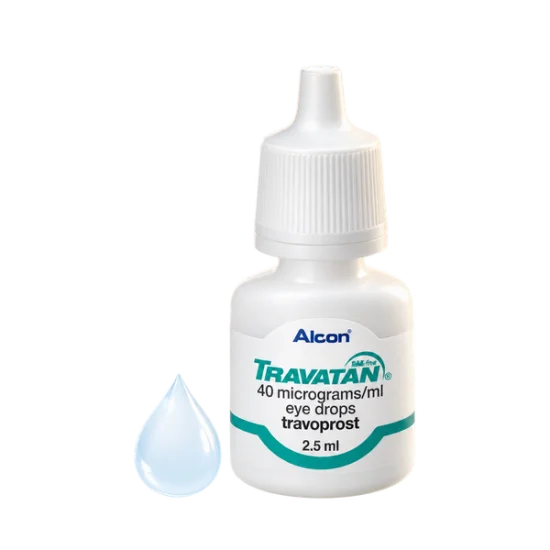
Travatan is a prescription-only treatment. The bottle supplied for this product contains 2.5 ml of ophthalmic solution.
Active ingredient and drug class
The active ingredient is travoprost. It acts mainly through prostaglandin-related pathways that increase uveoscleral drainage. This gives fluid inside the eye an additional route to leave the eye, helping bring pressure towards the target set by the ophthalmologist.
Travoprost 0.004% Eye Drop Solution is a commonly recognised formulation description for travoprost products, while the exact supplied formulation should match the prescription. Travoprost is classified as an antiglaucoma medicine and a prostaglandin analogue.
One practical detail is easy to miss: the bottle tip should never touch the eyelashes, eyelid, or eye. Contact can contaminate the solution and may also transfer organisms to the eye.
These formulations are not automatically interchangeable for every patient. Preservative exposure can matter when a person has ocular-surface irritation, dry-eye symptoms, or a history of sensitivity. A different bottle may feel different even when the active ingredient is the same.
| Formulation | Active ingredient | Main consideration |
|---|---|---|
| Travatan eye drops | Travoprost | Prescription pressure-lowering treatment |
The choice of formulation depends on the prescription, eye findings, previous tolerability, and local availability. Do not change between bottles without an ophthalmic review.
Dosage and administration
Use Travatan once daily or at another frequency only as prescribed for the individual treatment plan. The dose is decided individually, taking age, other medicines, and health conditions into account.
Step-by-step instillation technique
- Wash and dry your hands.
- Remove contact lenses before applying the drops.
- Tilt the head back and gently pull down the lower eyelid.
- Hold the bottle above the eye without touching the eye, lashes, or eyelid.
- Instil the prescribed drop into the lower eyelid pocket.
- Close the eye gently instead of blinking repeatedly.
- Apply gentle pressure at the inner corner of the closed eye if punctal occlusion has been advised.
- Wipe away excess fluid from the skin with clean tissue.
- Replace the bottle closure without touching the dropper tip.
The conjunctival sac holds only a small volume. A second drop usually spills onto the cheek rather than increasing the amount absorbed by the eye.
Timing, storage, and contact lenses
Travatan is commonly administered in the evening because prostaglandin analogues are generally used once daily. Use it at the same time each day unless the prescriber gives different instructions.
Soft contact lenses should be removed before application and usually remain out for at least 15 minutes afterwards. Contact lenses can absorb preservatives and may become uncomfortable when they are reinserted too soon.
If several eye medicines are prescribed, leave the interval specified by the ophthalmologist between liquid drops. Ophthalmic ointment is generally applied after liquid drops because ointment can interfere with absorption.
When not to use it
Known allergy to travoprost or a component of the ophthalmic formulation.
Uveitis, iritis, or other intraocular inflammation requires careful assessment. Treatment also needs careful review in patients with a history of macular oedema, retinal disease, aphakia, or certain lens-related complications.
When this is not for you
Talk to the prescribing eye specialist before using Travatan if you have current or previous uveitis, iritis, or another inflammatory eye condition. You should also discuss a history of macular oedema, retinal disease, aphakia, lens-related complications, retinal surgery, or previous eye surgery. Pregnancy, breastfeeding, paediatric treatment, and planned eye surgery should be discussed before starting treatment. Seek medical review for new eye inflammation, central vision distortion, a marked change in iris colour, severe eyelid swelling, persistent eye pain, or a suspected reaction to travoprost.
Possible side effects
The most common local reaction is eye redness. Travoprost may also cause burning, stinging, itching, watering, blurred vision immediately after application, or a foreign-body sensation.
Side effects can be mild and temporary, yet severe or painful redness needs clinical assessment.
Common local reactions
Travoprost can cause conjunctival hyperaemia, which means increased blood flow makes the white of the eye look red. Redness may be more noticeable shortly after the drop is applied. Persistent discomfort, marked swelling, discharge, or worsening pain should not be treated as routine irritation.
Eyelash changes can include increased length, thickness, or number. These changes may be more noticeable on one side when one eye receives treatment or when drops regularly run onto the eyelid.
Iris pigmentation and cosmetic changes
Travoprost may increase brown pigmentation in the iris. This effect can be more visible in mixed-colour irises, such as green-brown or blue-brown eyes. The colour change may persist after treatment has stopped.
A new difference between the two irises, an unexpected colour change, or associated inflammation warrants review by an eye specialist. The pigmentation change itself is not the same as acute eye injury, but it should be documented during follow-up.
Macular oedema and vision changes
Macular oedema is swelling in the central retina. It can cause blurred or distorted central vision. Travoprost may increase the risk in susceptible patients, including people with certain retinal disorders or a history of eye surgery.
Report new central blur, distortion, flashes, or a sudden reduction in vision promptly. Sudden vision loss or severe eye pain requires urgent medical care.
Severe allergic reactions
A severe allergic reaction may cause facial or eyelid swelling, widespread hives, wheezing, or difficulty breathing. These symptoms require emergency care rather than another dose followed by observation.
The FDA prescribing information describes ocular redness, iris pigmentation, eyelash changes, macular oedema, and hypersensitivity among the recognised safety considerations for travoprost ophthalmic treatment [2].
Therapeutic indications
Travatan is used for open-angle glaucoma and ocular hypertension. Open-angle glaucoma involves progressive damage to the optic nerve, often associated with raised intraocular pressure. Ocular hypertension means pressure is higher than the usual range, without necessarily indicating established glaucoma.
Open-angle glaucoma and ocular hypertension
Open-angle glaucoma can progress quietly. A person may have no pain, blurred vision, or noticeable change while optic-nerve injury continues. Ocular hypertension does not always become glaucoma, but the level of risk varies with pressure, optic-nerve appearance, corneal thickness, age, family history, and visual-field findings.
The European Medicines Agency describes travoprost as an ophthalmic prostaglandin analogue used to reduce elevated intraocular pressure in these conditions [1].
Comparison
| Active ingredient or category | Pharmacological approach | Formulation consideration |
|---|---|---|
| Latanoprost | Prostaglandin-related increase in fluid outflow | Individual response and tolerability vary |
| Bimatoprost or tafluprost | Prostaglandin-related pressure reduction | Preservative profile and local effects differ between products |
There is no single option that suits every patient. The selection can depend on target pressure, eye-surface symptoms, iris colour, eyelash effects, previous treatment response, and adherence.
Common mistakes
The most frequent errors are practical rather than pharmacological:
- Stopping treatment because vision feels normal.
- Applying extra drops to compensate for a missed dose.
- Touching the dropper tip against the lashes or eye.
- Instilling several liquid drops immediately one after another.
- Reusing contact lenses too soon after application.
- Changing to a different travoprost bottle without review.
- Confusing two bottles with similar caps.
- Judging treatment success by redness or comfort instead of eye-pressure checks.
- Failing to mention previous retinal disease or eye surgery.
- Allowing drops to run repeatedly onto the eyelid skin.
Glaucoma may remain symptomless while optic-nerve injury progresses. Attendance at scheduled reviews is part of treatment, even when the eyes feel unchanged.
What doctors say
In clinical practice, ophthalmologists usually judge Travatan by measured pressure, optic-nerve findings, visual fields, and adherence rather than by symptoms alone. A patient can have comfortable eyes and stable vision while still needing treatment.
Doctors also pay attention to practical barriers. A patient who cannot instil the drop without touching the eye may need technique coaching, a different bottle position, or help from a trained family member. A patient who develops persistent redness may need a formulation review rather than simply abandoning pressure treatment.
One useful distinction is between pressure control and visual recovery. Travatan can reduce pressure and help lower the risk of further optic-nerve injury, but it does not regenerate established nerve damage.
Common questions
What should I do if the expected pressure result does not come?
Do not increase the number of drops yourself. The ophthalmologist may review instillation technique, adherence, ocular-surface symptoms, other medicines, and the measured pressure before adjusting treatment. The EMA glaucoma guideline from 2012 describes treatment response as an individual clinical matter, assessed through follow-up rather than symptoms alone [3].
Can Travatan cause eye redness?
Yes. Eye redness is a recognised local effect of travoprost and may be more noticeable soon after application. Mild redness can occur without serious injury, but severe pain, sudden vision loss, marked swelling, discharge, or worsening inflammation needs prompt assessment. FDA ophthalmic safety information from 2018 identifies conjunctival hyperaemia among the expected adverse reactions reported with travoprost [4].
Which habits can help or hinder the result?
Using the prescribed dose at a consistent time helps reduce missed applications. Touching the tip, applying drops back-to-back, wearing contact lenses immediately afterwards, or stopping because vision feels normal can interfere with safe treatment. Regular eye reviews and accurate technique support assessment of intraocular pressure; the National Institute for Health and Care Excellence (NICE) guidance published in 2017 also supports structured glaucoma follow-up.
Which condition rules Travatan out?
A known allergy to travoprost or a component of the ophthalmic formulation rules out its use. A suspected allergic reaction should not be tested by applying another dose. Uveitis, retinal disease, macular oedema, aphakia, and previous eye surgery require discussion with the prescribing ophthalmologist because they may alter the risk assessment. The World Health Organization's 2019 World report on vision supports specialist assessment when glaucoma risk factors may affect vision.
What should be discussed with a doctor before starting Travatan?
Mention previous eye surgery, retinal disease, uveitis, macular oedema, contact-lens use, pregnancy, breastfeeding, and every eye medicine or systemic medicine currently used. Explain any history of severe reactions to eye drops. MOHAP and the FDA prescribing information from 2018 support clinician-led selection of prescription eye treatments, with follow-up based on intraocular pressure and optic-nerve findings.
Do you offer anonymous delivery?
Your order will be securely packed and shipped within 24 hours. This is exactly what your package will look like (images of an actual item sent). It has the size and look of a regular private letter (24x11x0.7 cm) and its contents cannot be seen.
Comparison
Sources
- European Medicines Agency (2019). Summary of Product Characteristics (SmPC) — travoprost.
- U.S. Food and Drug Administration (2015). Travatan Z (travoprost ophthalmic solution) Prescribing Information.
- European Medicines Agency (2012). Guideline on clinical investigation of medicinal products for the treatment of glaucoma.
- U.S. Food and Drug Administration (2018). Travoprost ophthalmic solution: Prescribing Information.