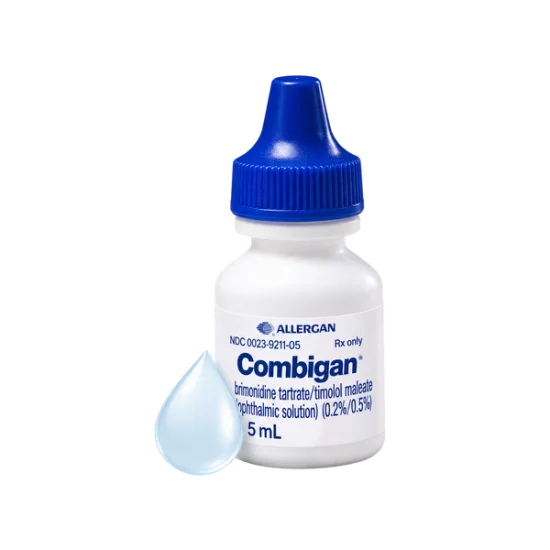
Combigan
Active ingredient: Brimonidine, Timolol
Delivery: from 4 days
- Worldwide Delivery4-7 business days
- Quality GuaranteedOnly original products
- Bonus pillsSave up to 80%
- 24/7 SupportOur team of pharmacists is available 24/7 to help you
Combigan eye drops are instilled into the affected eye, usually twice daily at about 12-hour intervals. They treat raised eye pressure in open-angle glaucoma and ocular hypertension. Brimonidine lowers fluid production, while timolol reduces aqueous humour formation through a separate pathway.
Product information
Combigan is a fixed-dose ophthalmic solution containing brimonidine tartrate and timolol maleate. It belongs to the combination of an alpha-2 adrenergic agonist and an ophthalmic beta-blocker used to lower intraocular pressure.
Brimonidine and Timolol Pharmacology
Brimonidine is an alpha-2 adrenergic agonist. It stimulates alpha-2 receptors in the eye and reduces the formation of aqueous humour.
Timolol is an ophthalmic beta-blocker. It reduces beta-receptor stimulation in the ciliary body, which decreases aqueous humour production.
Together, brimonidine/timolol lowers eye pressure with one bottle instead of separate bottles for each active ingredient. A fixed combination can reduce the number of instillation steps, although it still exposes the patient to the precautions linked with both ingredients.
Fixed-Dose Ophthalmic Solution Strength
A higher concentration or extra drop should not be substituted for the prescribed regimen. The U.S. Food and Drug Administration prescribing information identifies the combination as a treatment for elevated intraocular pressure associated with open-angle glaucoma or ocular hypertension [1].
How it affects the body
Brimonidine lowers fluid production, while timolol reduces aqueous humour formation through a separate pathway. Brimonidine stimulates alpha-2 receptors in the eye and reduces the formation of aqueous humour. Timolol reduces beta-receptor stimulation in the ciliary body, which decreases aqueous humour production.
Ingredients
Combigan is a fixed-dose ophthalmic solution containing brimonidine tartrate 0.2% and timolol maleate 0.5%. Brimonidine and timolol belong to different pharmacological groups, so the combination lowers intraocular pressure through complementary actions. The solution is supplied in bottles for eye-drop use.
Aqueous humour is the clear fluid produced inside the front part of the eye. If its production and drainage are not balanced, pressure can rise and place stress on the optic nerve.
| Active ingredient | Salt form and strength | Pharmacological role |
|---|---|---|
| Brimonidine | Brimonidine tartrate 0.2% | Alpha-2 adrenergic agonist that reduces aqueous humour production and supports outflow |
| Timolol | Timolol maleate 0.5% | Ophthalmic beta-blocker that reduces aqueous humour production |
Fixed-Dose Ophthalmic Solution Strength
Combigan contains brimonidine tartrate 0.2% and timolol maleate 0.5% as an ophthalmic solution.
Dosage and administration
The usual adult regimen in the Combigan prescribing information is one drop in the affected eye twice daily, approximately 12 hours apart. The prescriber determines the individual regimen after considering age, other medicines, eye pressure, cardiovascular history, respiratory conditions, and the response to treatment.
- Wash and dry the hands before instillation.
- Shake the bottle if the local product instructions require shaking.
- Tilt the head back and gently pull down the lower eyelid.
- Hold the bottle above the eye without touching the eye or surrounding skin.
- Instil one drop into the pocket formed by the lower eyelid.
- Close the eye gently rather than blinking repeatedly.
- Press lightly at the inner corner of the closed eye for about one minute.
- Wipe excess liquid from the cheek.
- Replace the cap promptly.
Punctal occlusion means gently pressing the inner corner of the closed eye after the drop is instilled. This can reduce drainage through the tear duct and may limit systemic absorption of brimonidine and timolol.
If more than one ophthalmic medicine is prescribed, leave at least five minutes between different eye drops unless the prescriber gives different instructions. An ointment is generally used after liquid drops because it can interfere with absorption.
Standard Prescribing-Information Dose
Combigan is normally used as one drop in the affected eye twice daily, around 12 hours apart. The dose is decided individually, taking age, other medicines, and health conditions into account.
Do not use several drops to make up for a missed administration. The eye can retain only a small volume, so extra liquid often runs onto the cheek rather than improving pressure control.
Correct Instillation Technique
A common mistake is squeezing the bottle too hard and releasing several drops. One drop is generally the intended volume. After instillation, gentle eye closure and punctal occlusion are more useful than repeated blinking.
Do not share the bottle. Even when the bottle appears clean, sharing can transfer organisms between users and may expose another person to a medicine prescribed for a different eye-pressure target.

When not to use it
Combigan is contraindicated or requires careful clinical assessment in people with:
- Asthma
- Severe chronic obstructive pulmonary disease
- Sinus bradycardia
- Second- or third-degree atrioventricular block without appropriate pacing
- Overt cardiac failure
- Serious conduction disorders
- A history of fainting or unexplained slow pulse
A previous hypersensitivity reaction to brimonidine, timolol, or any component of the ophthalmic solution rules out further use until the prescriber has assessed the reaction.
When this is not for you
This treatment is not for you if you have asthma, severe chronic obstructive pulmonary disease, a markedly slow heartbeat, significant heart block, overt heart failure, or a previous serious reaction to brimonidine or timolol.
Timolol is a beta-blocker. In susceptible people, ophthalmic timolol can narrow the airways, lower heart rate, reduce blood pressure, or worsen cardiac failure. A history of respiratory disease, slow pulse, heart block, low blood pressure, or heart failure must be disclosed before treatment starts.
Combigan can also require caution in people with poor circulation, depression, diabetes, thyroid disease, or conditions that make low blood pressure more hazardous.
Combigan is not used in children younger than two years. Use in children and adolescents requires age-appropriate medical supervision because brimonidine can cause pronounced drowsiness and respiratory or cardiovascular effects in young patients.
Possible side effects
Combigan can cause local eye reactions because the solution contacts the conjunctiva and cornea. Timolol can also produce systemic beta-blocker effects after absorption through the eye, especially when punctal occlusion is not used.
Common Ocular Reactions
Reported local reactions include:
- Eye redness
- Eye itching
- Eye irritation
- Burning or stinging after instillation
- Watery eyes
- Conjunctival follicles
- Temporary blurred vision
- Dry-eye discomfort
Conjunctival follicles are small raised bumps on the inner eyelid or conjunctiva. They can occur as part of an inflammatory or allergic response. Persistent redness, itching, swelling, or discomfort may require a treatment review rather than repeated use of additional drops.
Temporary blurred vision can occur immediately after instillation. Driving or operating machinery should wait until vision is clear and drowsiness is absent.
Systemic and Emergency Reactions
Brimonidine may cause drowsiness, fatigue, dizziness, or dry mouth. Timolol may contribute to a slow pulse, low blood pressure, conduction problems, bronchospasm, or worsening heart failure in susceptible people.
Urgent medical assessment is needed for:
- Wheezing or severe breathing difficulty
- Facial, eyelid, tongue, or throat swelling
- Fainting or near-fainting
- Chest symptoms
- An unusually slow heartbeat
- Severe weakness with low blood pressure
- Marked breathlessness or signs of worsening heart failure
A suspected allergic reaction is a reason to stop further instillation until urgent clinical advice is obtained. Severe breathing symptoms, fainting, or facial swelling require emergency assistance.
The FDA prescribing information describes the need to consider systemic effects even though Combigan is applied to the eye. A small amount can pass through the tear drainage system and enter the circulation .
Therapeutic indications
Combigan is used for open-angle glaucoma and ocular hypertension. It is generally selected when pressure reduction from one topical medicine is insufficient or when a fixed combination is clinically suitable.
Open-angle glaucoma often progresses without pain or obvious changes in vision. Ocular hypertension means that intraocular pressure is elevated without the established optic-nerve damage required for a glaucoma diagnosis. An eye examination, pressure measurement, optic-nerve assessment, and visual-field testing help distinguish these conditions.
Raised intraocular pressure can contribute to optic-nerve damage. Progressive damage may result in permanent vision loss. Combigan lowers pressure and can help reduce pressure-related risk, but it does not restore optic-nerve tissue that has already been lost.
The absence of symptoms does not show that pressure is controlled. A person can feel well while pressure remains above the target selected by the ophthalmologist.
Comparison
Treatment selection depends on pressure targets, optic-nerve findings, previous tolerability, other diseases, and the number of daily applications a person can manage.
| Treatment approach | Main practical feature | Main limitation |
|---|---|---|
| Combigan | Brimonidine and timolol in one fixed combination | Carries the local and systemic precautions of both ingredients |
| Separate brimonidine and timolol drops | Each medicine can be adjusted independently | More bottles and more opportunities for missed applications |
| Betaxolol-containing treatment | Related ophthalmic beta-blocker approach | Requires clinical assessment and may not suit every cardiovascular or respiratory profile |
Fixed Combination Versus Separate Drops
Combigan reduces bottle burden compared with separate brimonidine and timolol drops. Fewer bottles may make the daily routine easier, but a fixed combination does not allow independent adjustment of one active ingredient.
Separate drops can be useful when the prescriber wants to change one component while retaining the other. They also create more spacing and administration steps.
Betaxolol and Related Beta-Blocker Options
Betaxolol is another ophthalmic beta-blocker option. Its selection depends on the desired pressure reduction, previous response, eye findings, and cardiovascular or respiratory history.
No glaucoma medicine is universally best. The appropriate choice is the one that meets the pressure target with tolerable local and systemic effects.
Common mistakes
A common practical problem is poor instillation technique. The patient may miss the eye, touch the cornea with the bottle, blink repeatedly, or apply several drops because the first one was not felt.
Common mistakes include:
- Doubling the next dose after a missed application
- Stopping when the eyes feel normal
- Wearing contact lenses during instillation
- Sharing the bottle
- Ignoring wheezing, fainting, or a markedly slow pulse
- Applying several eye drops without spacing them
- Driving immediately after blurred vision or drowsiness
- Using another person’s pressure-lowering medicine
- Forgetting to mention beta-blockers or heart medicines
What doctors say
In clinical practice, ophthalmologists focus on measured intraocular pressure, optic-nerve appearance, visual fields, and adherence rather than on whether the eyes feel comfortable. Glaucoma can remain symptomless while damage progresses, so feeling normal is not a reason to stop treatment.
Timolol and brimonidine lower eye pressure; they do not provide a sensation that confirms the pressure has reached its target. Follow-up testing remains necessary.
The WHO describes glaucoma as a major cause of irreversible vision impairment and stresses the importance of detection and ongoing management [2].
Common questions
What should be discussed with a doctor before starting Combigan?
Tell the prescriber about asthma, severe chronic obstructive pulmonary disease, slow pulse, heart block, heart failure, low blood pressure, fainting, and previous eye-drop allergies. A full list of cardiovascular medicines, antidepressants, other eye drops, and sedatives is also relevant. The FDA prescribing information from 2020 identifies respiratory and cardiovascular conditions that can make timolol-containing eye drops unsuitable. The FDA prescribing information from 2020 also supports medicine review when a topical ophthalmic treatment may have systemic effects. The ophthalmologist can use this history to choose a safer plan.
What should be done after a missed Combigan dose?
Instil the missed drop when remembered unless the next dose is close. If the next dose is near, skip the missed application rather than using two drops together. The FDA prescribing information from 2020 advises against doubling after a missed dose. The WHO’s 2019 vision guidance also supports consistent treatment routines for chronic eye disease management.
What happens if Combigan is stopped, and is tapering required?
Stopping Combigan can allow intraocular pressure to rise again, even when the eyes feel normal. The medicine should not be stopped suddenly without a treatment plan because pressure control may be lost. The NICE glaucoma guideline from 2022 links ongoing management with pressure monitoring and optic-nerve protection. EMA ophthalmic safety information from 2023 supports clinician-led changes when a pressure-lowering treatment is discontinued.
Can Combigan be used during pregnancy or breastfeeding?
Pregnancy and breastfeeding require an individual risk assessment because brimonidine and timolol can produce systemic effects after ophthalmic administration. The prescriber considers the severity of the eye condition, alternative treatments, and the possibility of infant exposure. The FDA label from 2020 advises discussing pregnancy and lactation before treatment. EMA medicine information from 2023 also treats reproductive use as a situation requiring clinical review rather than automatic continuation.
Which condition rules out Combigan?
Asthma or severe chronic obstructive pulmonary disease can rule out Combigan because timolol may trigger bronchospasm. Marked bradycardia, certain heart blocks, overt heart failure, or serious hypersensitivity to brimonidine or timolol are also contraindication concerns. The FDA prescribing information from 2020 lists these cardiovascular, respiratory, and allergy restrictions. The FDA prescribing information from 2020 supports recording these conditions before a beta-blocker-containing ophthalmic treatment is started.
Is Combigan suitable for older adults?
Older adults can use Combigan when the prescriber considers the person’s eye pressure, cardiovascular status, respiratory history, kidney and liver health, and other medicines. Age may increase sensitivity to dizziness, low blood pressure, slow pulse, or drowsiness. The NICE guideline from 2022 recommends monitoring glaucoma treatment through pressure and optic-nerve assessment rather than symptoms alone. WHO guidance published in 2019 also emphasises continued follow-up for chronic vision-threatening conditions.
Do you offer anonymous delivery?
Your order will be securely packed and shipped within 24 hours. This is exactly what your package will look like (images of an actual item sent). It has the size and look of a regular private letter (24x11x0.7 cm) and its contents cannot be seen.
Comparison
Combigan Contact-Lens Use and Storage
Contact lenses should be removed before Combigan is instilled. Preservatives in ophthalmic solutions may be absorbed by soft lenses and can increase irritation.
Replace lenses only after the interval specified in the local product information. Persistent discomfort, redness, or blurred vision while wearing lenses requires assessment by an eye-care professional.
Contact-Lens Removal and Replacement
Remove contact lenses before applying the drop. Instil Combigan with clean hands, close the eye gently, and keep the bottle tip away from the lens and eye surface.
A common practical problem is putting the lens back immediately after the drop. This can trap preservative against the cornea and may make burning or watering worse.
Bottle Hygiene and Storage
Keep the bottle capped when it is not being used. Store it according to the product instructions, away from excessive heat and direct sunlight. Do not transfer the solution into another container.
Do not use a bottle if the solution has visibly changed appearance or if the dropper tip has touched a contaminated surface. The local product information sets the discard period after opening, so the opening date should be recorded when the bottle is first used.
Sources
- U.S. Food and Drug Administration (2020). Combigan (brimonidine tartrate/timolol maleate) ophthalmic solution prescribing information.
- World Health Organization (2019). World report on vision.