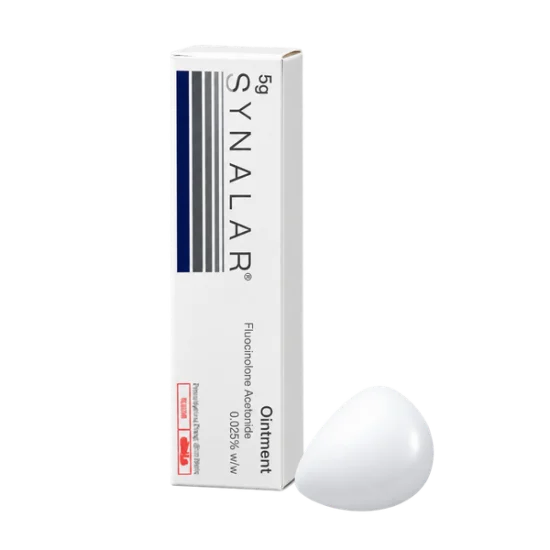
Synalar
Active ingredient: Fluocinolone Acetonide
Delivery: from 4 days
- Worldwide Delivery4-7 business days
- Quality GuaranteedOnly original products
- Bonus pillsSave up to 80%
- 24/7 SupportOur team of pharmacists is available 24/7 to help you
Synalar helps reduce inflammation, redness and itching in responsive skin conditions such as eczema, dermatitis and selected psoriasis presentations. It contains fluocinolone acetonide, a topical corticosteroid that calms excessive inflammatory activity in the skin.
Product information
The ointment is intended for short, controlled use on affected areas, with the treatment plan matched to the diagnosis and body site. The affected area should be checked before treatment begins.
How it affects the body
Fluocinolone acetonide acts locally in the skin as a topical corticosteroid. It reduces inflammatory signalling, decreases inflammatory immune-cell activity and narrows superficial blood vessels, thereby reducing redness, swelling and itching.
Ingredients
Synalar ointment contains fluocinolone acetonide, a topical corticosteroid used to reduce inflammatory skin symptoms. The supplied formulation contains fluocinolone acetonide 0.025%. Corticosteroids applied to the skin are anti-inflammatory treatments; they are unrelated to anabolic steroids used to increase muscle mass.
Fluocinolone acetonide reduces the release and activity of several inflammatory mediators in the skin. This can ease redness, swelling, itching and irritation, but it does not remove the underlying tendency toward atopic eczema or psoriasis. The official product information classifies topical corticosteroids according to their strength, formulation and licensed uses [1].
The ointment base is suited to dry, rough or scaly areas because it forms an occlusive layer that reduces water loss from the skin. This same property can increase absorption, especially when the ointment is applied to large areas, broken skin or skin covered by a dressing.
Fluocinolone Acetonide Function
Fluocinolone acetonide acts locally in the skin. It reduces inflammatory signalling and narrows small superficial blood vessels, which can lessen redness and swelling. It also decreases activity from immune cells involved in inflammatory rashes.
Symptom relief does not prove that the original diagnosis was correct. A steroid may temporarily reduce redness from an infection while the infection continues underneath.
Dosage and administration
- Wash and dry your hands before applying Synalar.
- Spread a thin layer over the affected skin only.
- Avoid applying it to unaffected skin where possible.
- Follow the prescribed frequency rather than applying it whenever itching returns.
- Wash your hands after application unless the hands are the treated area.
- Keep the ointment away from the eyes and eyelids unless a clinician has specifically directed its use there.
- Do not cover treated skin with plastic, tight dressings or bandages unless specifically instructed.
- Use a fingertip-unit approach when the prescriber has explained the required amount for the affected body area.
- If an application is missed, apply it when remembered unless the next application is close; do not apply a double layer.
Treatment duration depends on the diagnosis, body site, age and response. The dose is decided individually, taking age, other medicines and health conditions into account. Face, groin, genital skin, skin folds and areas under dressings absorb topical corticosteroids more readily than thicker skin on the palms or soles.
More ointment is not a faster route to recovery. Excess application increases exposure and may raise the risk of skin thinning, stretch marks and other corticosteroid effects.
When not to use it
Synalar is not suitable for everyone. It should not be used on an untreated skin infection, including suspected fungal, bacterial or viral infection, unless an appropriate treatment plan covers both problems. It is also generally unsuitable for acne, rosacea and perioral dermatitis because corticosteroids can worsen these conditions or alter their appearance.
Extra caution applies to:
- The face and eyelids.
- Groin, genital skin and skin folds.
- Broken, ulcerated or severely damaged skin.
- Large treatment areas.
- Children, unless age-appropriate medical guidance is in place.
- Pregnancy and breastfeeding, where the smallest suitable area and duration are preferred.
- Areas covered by dressings or tight clothing.
- A rash that has not received a clear diagnosis.
Synalar should not be placed in the eyes. Repeated facial or eyelid exposure can contribute to skin thinning and, if the medicine reaches the eye, may increase the risk of ocular complications. Specific medical advice is needed when treating close to the eyes.
When this is not for you
A steroid may be unsuitable when the rash is caused by a bacterial, viral or fungal infection, acne, rosacea or perioral dermatitis. Diagnosis matters because appearance alone cannot reliably distinguish inflammatory disease from infection.
Topical corticosteroids may mask or worsen untreated infection. A reduction in redness does not necessarily mean the underlying condition is improving. NOT for you if the rash is undiagnosed, infected, or located on sensitive skin without clinician guidance.
Possible side effects
Short courses of topical corticosteroids are often tolerated locally, but irritation can occur. Possible reactions include burning, stinging, dryness, folliculitis and worsening of the rash. Some people develop contact sensitivity to the active ingredient or an excipient.
Longer or excessive use increases the risk of:
- Skin thinning, also called skin atrophy.
- Stretch marks, especially in folds.
- Small visible blood vessels.
- Acne-like spots or folliculitis.
- Changes in pigmentation.
- Rebound redness or itching after stopping prolonged use.
- Delayed recognition of an untreated infection.
- Systemic corticosteroid effects when absorption is substantial.
Skin atrophy means that the skin becomes thinner and more fragile. Tachyphylaxis describes a reduced response after repeated exposure, although worsening disease can also reflect an incorrect diagnosis, infection or continued exposure to a trigger.
Absorption rises when Synalar is used over a large area, on broken skin, under occlusion or for longer than prescribed. Children have a higher skin-surface-area-to-body-weight ratio, so they may be more vulnerable to systemic absorption.
Stop using the ointment and seek urgent care for facial swelling, swelling of the lips or tongue, breathing difficulty or a rapidly spreading allergic reaction. Rapidly worsening redness, warmth, pus, fever or increasing pain can indicate infection and also needs prompt assessment.

Therapeutic indications
Synalar may be prescribed for inflammatory skin disorders, including atopic eczema, contact dermatitis and selected psoriasis presentations. It is chosen when inflammation causes symptoms such as persistent itching, redness, scaling or thickening.
| Condition | Typical inflammatory features | Clinical consideration |
|---|---|---|
| Atopic eczema | Itching, redness, dryness and inflamed patches | Moisturising care remains important between flare treatments |
| Contact dermatitis | Red, itchy or burning skin after exposure | Removing the trigger is part of management |
| Selected psoriasis | Well-defined, scaly plaques | Thick plaques may respond differently from thin plaques |
Topical corticosteroids are used to treat atopic eczema because they reduce the inflammatory flare. Synalar may also be prescribed for selected cases of scalp psoriasis or other psoriasis sites when the formulation is suitable for that body area. Thick plaques can limit penetration, while hairy areas may require a different vehicle.
Comparison
Synalar contains fluocinolone acetonide. Other topical corticosteroids contain different active substances and may have different potency classifications, vehicles and licensed uses. A stronger corticosteroid is not automatically a better choice.
| Active ingredient or formulation | Main distinction | Key caution |
|---|---|---|
| Fluocinolone acetonide in Synalar | Topical corticosteroid for selected inflammatory dermatoses | Use is controlled by body site and duration |
| Clobetasol propionate in Dermovate | Very potent topical corticosteroid | Greater misuse and absorption risk |
| Betamethasone valerate or beclomethasone dipropionate preparations | Different corticosteroid options with formulation-specific uses | Not interchangeable with Synalar |
Dermovate contains clobetasol propionate, a very potent corticosteroid. Betamethasone valerate preparations may combine the steroid with coal tar solution for selected psoriasis care. Beclomethasone dipropionate ointment may be used for atopic eczema and, in selected plans, with wet wraps.
Some compounded or specialist formulations combine clobetasol propionate with propylene glycol to increase penetration. Others combine clobetasol propionate with salicylic acid for thick or hyperkeratotic plaques, including some palmoplantar conditions. Salicylic acid helps soften scale; it does not make those products interchangeable with Synalar.
The term Propaderm 1 in 10 has been used for a beclomethasone dipropionate ointment formulation. Local formularies determine how such preparations are classified and prescribed. The NHS Somerset Formulary and British Association of Dermatologists guidance support choosing topical corticosteroids by potency, site and diagnosis rather than by brand familiarity [2].
Common mistakes
Applying too much is common. The extra layer may increase absorption without producing faster control of the flare.
Other mistakes include:
- Using Synalar on an undiagnosed rash.
- Continuing treatment after the prescribed course.
- Applying it to unaffected skin.
- Covering the area without specific instructions.
- Using it on the face or folds without confirming suitability.
- Applying it close to the eyes and accidentally transferring ointment into the eye.
- Sharing the tube.
- Treating a rash with pus, warmth or spreading redness as though it were ordinary eczema.
- Stopping and restarting repeatedly without reviewing the diagnosis.
Topical corticosteroids can cause harm when used too frequently or for too long. They can also make an infection appear quieter while the infection progresses.
Wash your hands after application. Avoid touching the eyes until the hands are clean. If the hands are the treated area, remove excess ointment from the palms only as directed so the treatment is not immediately washed away.
What doctors say
In clinical practice, doctors usually assess three variables before choosing a topical corticosteroid: the diagnosis, the body site and the severity of inflammation. The same rash may need a different formulation on the scalp, face, groin or a thick plaque.
A clinician would also expect the treatment plan to include more than the steroid alone. For eczema, moisturising care and trigger reduction can support the skin barrier. For psoriasis, scale thickness, body-site sensitivity and relapse pattern influence the choice of treatment.
The usual goal is control of a flare, not indefinite daily application. If symptoms repeatedly return after a short course, the pattern may indicate ongoing exposure to an irritant, inadequate barrier care, infection or a diagnosis requiring reassessment. EMA topical-corticosteroid information also stresses that potency and duration should match the treated area and clinical need [3].
Common questions
How long does one Synalar application keep working?
The anti-inflammatory effect from one application is not measured as a fixed number of hours for every person. It depends on the condition, skin thickness, affected area, formulation and prescribed frequency. Fluocinolone acetonide acts locally, while visible improvement may take longer than the reduction in itching. EMA product information from 2024 supports using topical corticosteroids at the prescribed frequency rather than repeating applications whenever symptoms fluctuate .
Can Synalar be used with cosmetics, sunscreen or other topical products?
Cosmetics and sunscreen can be used around treated skin, but they should not be layered directly over Synalar unless the treatment plan permits it. Applying several topical products together can dilute the medicine, increase irritation or make it difficult to know which product caused a reaction. A practical approach is to apply Synalar to clean, dry affected skin and allow it to settle before using another product on nearby skin. Guidance from the British Association of Dermatologists in 2024 supports separating topical treatments when irritation or absorption is a concern .
Which condition rules out Synalar?
An untreated fungal, bacterial or viral skin infection is a concrete reason to avoid self-treating with Synalar. Pus, rapidly spreading redness, warmth, fever and increasing pain raise concern for infection rather than an uncomplicated eczema flare. Acne, rosacea and perioral dermatitis are also conditions in which topical corticosteroids may worsen the problem. WHO clinical guidance from 2020 advises confirming the diagnosis when a rash changes quickly or responds atypically .
How long does a Synalar course last, and is long-term use acceptable?
The course length is individual and depends on the diagnosis, body site, patient age and treatment response. Long-term continuous use should not be assumed to be acceptable, especially on the face, folds, genital skin, large areas or covered skin. Prolonged exposure can increase the risk of skin atrophy, stretch marks and systemic corticosteroid effects. EMA guidance from 2015 recommends matching treatment duration to clinical need and reviewing treatment when the expected response does not occur .
What should be done after a missed Synalar application?
Apply the missed amount when remembered unless the next scheduled application is close. If the next application is near, skip the missed application and continue with the normal schedule. Do not apply a thick double layer to compensate. FDA prescribing information from 2020 uses the same general principle: missed topical doses should not be replaced with excessive application [4].
Do you offer anonymous delivery?
Your order will be securely packed and shipped within 24 hours. This is exactly what your package will look like (images of an actual item sent). It has the size and look of a regular private letter (24x11x0.7 cm) and its contents cannot be seen.
Sources
- EMA (2024). Summary of Product Characteristics (SmPC) — fluocinolone acetonide.
- British Association of Dermatologists (2024). Topical corticosteroid guidance.
- EMA (2015). Guideline on the clinical investigation of medicinal products for the treatment of psoriasis.
- FDA (2020). Prescribing information — fluocinolone acetonide topical.